Amateur and university athletes are underserved when it comes to structured recovery guidance - with real consequences for their health and performance.
of surveyed athletes regularly trained despite feeling tired
had no access to structured recovery guidance
survey participants confirmed the gap before prototype development
Elite athletes have access to physiotherapists, psychologists, and expensive sports-science tools like WHOOP and Garmin Connect. Community and university athletes do not. ReSync bridges that gap with an affordable, ethically designed digital solution that makes evidence-based recovery guidance accessible to everyone - combining physical biometrics and nutritional guidance in a single application.
A commercial viability study covering market opportunity, cost planning, competitive landscape, and the Irish regulatory environment.
ReSync targets amateur athletes, university students and community sports clubs that cannot afford the overpriced platforms currently dominating the market. The application is not built around performance tracking - it focuses on recovery awareness, injury prevention and affordable access to sports-science insights that are currently reserved for elite athletes.
Students needing structured recovery without high subscription costs.
Gym-goers, runners and local club players wanting data-driven recovery.
Team-level wellbeing insights via anonymised coach dashboards.
A lean 3-person team model was used, benchmarked against Irish market salaries (Glassdoor, Indeed, Software Space) scaled to 0.3 - 0.5 FTE. Cloud costs were calculated using the AWS Pricing Calculator.
| Cost Category | Year 1 | Year 2 | Year 3 | Year 4 | Year 5 |
|---|---|---|---|---|---|
| Development & Technical | €19,000 | €39,000 | €40,500 | €42,000 | €43,500 |
| Cloud & Infrastructure (AWS) | €2,250 | €3,500 | €5,450 | €7,650 | €9,750 |
| Maintenance & Support | €1,300 | €2,000 | €3,100 | €4,200 | €5,200 |
| Marketing & User Acquisition | €2,100 | €3,400 | €5,000 | €6,700 | €8,600 |
| Legal, Security & Compliance | €3,200 | €2,000 | €2,400 | €2,900 | €3,300 |
| Employee Costs (3 persons) | €50,000 | €67,000 | €82,000 | €96,000 | €110,000 |
| Total Estimated Cost | €77,850 | €116,950 | €138,450 | €159,450 | €180,350 |
Used to assess the competitiveness and attractiveness of the digital health market (Porter, 1979; Gratton, 2025).
| Force | Rating | Key Reasoning |
|---|---|---|
| Threat of New Entry | Low technical barriers but GDPR & user-trust requirements raise them | |
| Supplier Power | AWS dominates but alternatives (Google Cloud, Azure) exist; API suppliers interchangeable | |
| Buyer Power | Many free alternatives; university athletes are highly price-sensitive | |
| Threat of Substitute | Apple Health, Garmin, Calm & MyFitnessPal address features individually | |
| Competitive Rivalry | Intense market but no competitor combines readiness, nutrition & mental health at low cost |
| Feature | ReSync | WHOOP 5.0 | HRV4Training | Athlytic |
|---|---|---|---|---|
| Price | €6-9/mo | €30/mo | €10/mo | €6/mo |
| Hardware Required | No | Yes (€399+) | No | No |
| Daily Readiness Score | ✓ | ✓ | ✓ | ✓ |
| Nutrition Guidance | ✓ Spoonacular | ✗ | ✗ | ✗ |
| Mental Health Monitoring | ✓ Planned | ✗ | ✗ | ✗ |
| CSV Data Import | ✓ | ✗ | ✓ | ✗ |
Freemium model: basic readiness score free; €6-9/month (or €60-90/year) for nutrition guidance, mental health monitoring & historical trends. Secondary revenue from coach dashboard licences.
Primary: university athletes, runners, gym-goers, amateur athletes, smartwatch users. Secondary: sports teams, personal trainers, educational institutions.
Universities, sports clubs, fitness influencers, Spoonacular API, AWS cloud infrastructure. New Frontiers Programme & Enterprise Ireland funding potential.
Enterprise Ireland Competitive Start Fund (€50k), New Frontiers Programme (SETU-delivered), PRSI Job Incentive Scheme for first employees.
A Flask-based prototype with a three-tier architecture, CSV data ingestion, rule-based readiness scoring, and Spoonacular nutrition recommendations.
A three-tier web architecture was used: a presentation layer (browser dashboard), an application layer (Flask backend), and a data layer (PostgreSQL managed via SQLAlchemy).
Athletes log in, upload a CSV exported from their smartwatch, and Flask parses and validates the file. The readiness scoring algorithm then processes the data, stores results in the database, and displays them on the dashboard. The Spoonacular API then delivers meal recommendations based on the resulting score.
Lightweight, well-documented, prior knowledge & easy to extend.
Structured health data storage; AWS RDS-ready for scaling.
Responsive interface without JavaScript framework overhead.
Personalised food & recipe recommendations. Free developer tier used.
Flask app on EC2, relational DB on RDS, CSV storage on S3.
Full change history, rollbacks, and collaborative development.
Registration & login with Flask session management. Passwords stored hashed, no plain-text credentials. Roles: athlete or coach.
At-a-glance readiness score with colour-coded status, score-breakdown pie chart, and 7-day historical bar chart.
Bypasses proprietary API paywalls. Accepts standard CSV exports from Apple Health and Garmin Connect. Flask validates and extracts required columns.
Rule-based algorithm combining sleep hours, 7-day rolling HRV baseline, and resting heart rate into a single 0-100 composite score.
Spoonacular API delivers personalised meal & recipe suggestions that adapt dynamically to the athlete’s current readiness score.
A walkthrough of the ReSync prototype - covering login, CSV upload, readiness scoring, and nutrition recommendations.
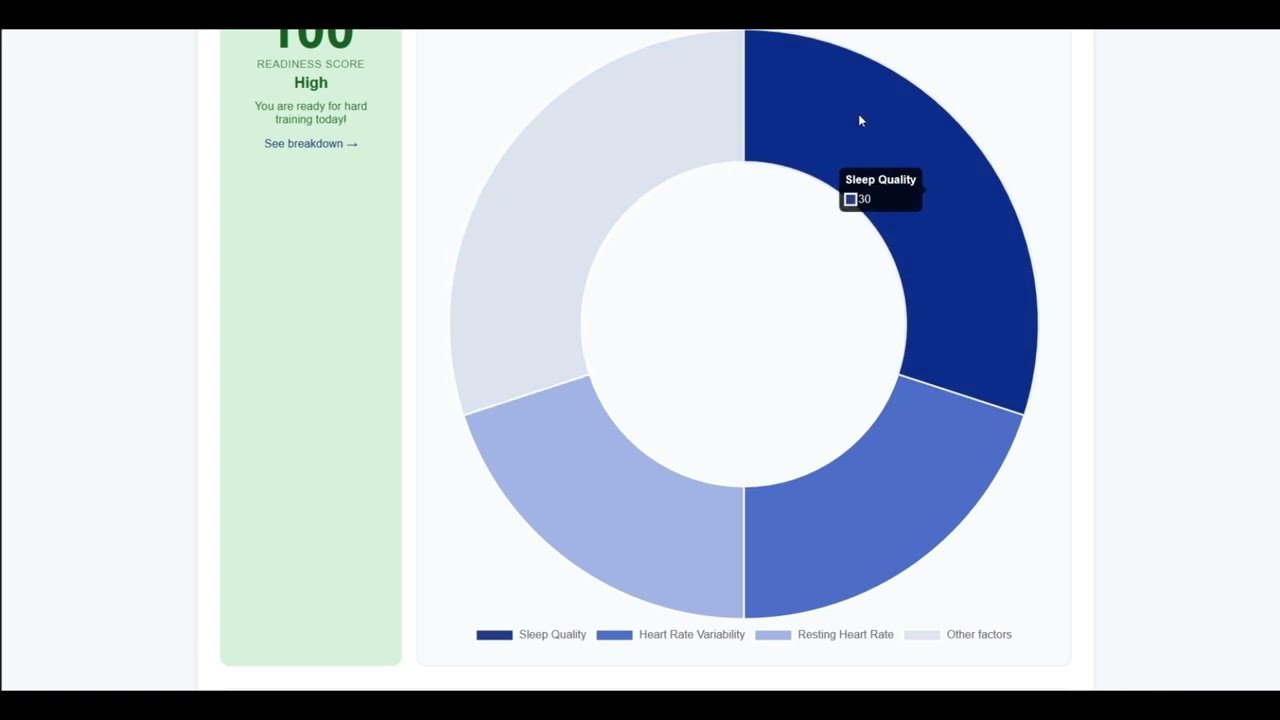
Three biometric inputs feed into a single actionable number on a 0-100 scale.
7-9 hours is optimal. Below this threshold the score is reduced proportionally.
7-day rolling average baseline. A drop of >15% below baseline triggers a penalty.
An elevation of >5 BPM above personal baseline signals incomplete recovery.
One number: train hard, train light, or rest today.
ReSync manages sensitive biometric and psychological data. Ethics are not bolted on - they shaped every technical decision from day one.
Health data in ReSync qualifies as “special category data” under GDPR Article 9 - the highest level of regulatory protection. The application requires explicit user consent, adheres to data retention and deletion policies, and ensures all data is encrypted at rest and in transit (EU, 2016/679).
User passwords are hashed and physiological data is stored in separate tables. Formal GDPR reviews are included in the 5-year cost plan (Year 1: €800).
Athletes face elevated mental health risks from competitive pressure (Watson, 2017). The application incorporates mood check-ins and stress indicators using non-judgemental, empowering language -negative framing is never used.
When low psychological indicators are detected, ReSync provides gentle prompts encouraging the user rather than alarming messages that could cause distress.
The normalisation of overtraining in amateur sport is a significant ethical risk, particularly among young athletes. ReSync monitors physiological markers to identify early warning signs before they become injuries.
Rest-day recommendations include evidence-based contextual explanations, helping athletes make decisions grounded in data rather than coaching pressure alone.
All application messaging is designed to avoid guilt, fear or shame. A positive communication framework is used throughout. For example, a low readiness day shows:
“Your body is signalling it needs rest today. Consider lighter activity and focus on sleep tonight.”
This preserves user autonomy and reduces risk of harm from negative self-appraisal.
All nutritional output is explicitly positioned as general sports nutrition suggestions, not medical advice. A visible disclaimer accompanies every recommendation and the system does not account for individual medical conditions or dietary restrictions - those remain the domain of registered dietitians.
The ethical responsibility is to provide helpful context, not clinical care.
The coach dashboard shows team wellbeing in an anonymised aggregate format, giving coaches insight into overall team readiness without exposing individual athlete data.
Individual data is never accessible to coaches without explicit athlete consent. This protects privacy while supporting positive culture change in team training environments.
Design choices actively prevent physical and psychological harm to users.
Users always have the final say. The app informs; it never coerces.
All recommendations show their source and limitations clearly.
GDPR compliance and data minimisation are architectural decisions, not afterthoughts.
Boni Milingnayo
Student ID: C00284515
BSc (Hons) IT Management - Year 4
South East Technological University (SETU)
This was developed as the final year project, exploring how digital technology can be applied ethically to improve athlete wellbeing at scale - particularly for university and community sport organisations that lack access to costly sports-science support. The project was evaluated across three streams: business viability, technical development, and ethical responsibility.